And so we return to Martin Wilfarth and his highly unorthodox ideas of intertidal dinosaurs. Let us jump right in with the next major group:
“The Breath-Neck Saurians”
Die Atemhalssaurier (Sauropoda)
As the tidal levels sank in the Jurassic, down to a range of about 10 metres (Wilfarth 1949a, p. 35), it was no longer needed for dinosaurs to perform breath-jumps or rear onto their hindlegs and especially the large plateosaurs could simply lift up their long necks to breathe. But bipedalism on land restricted how long their neck could be, so they eventually became quadrupedal to free themselves of that restraint (Wilfarth 1949a, p. 39 – 40).
 |
| Fig. 1: Wilfarth's reconstruction of Diplodocus both in bipedal and quadrupedal posture. It looks strangely modern if one just thinks away the water. Their whip-tails are buried in the sediment to act as anchors (Source: Wilfarth 1949a, p. 34). |
As you could have probably guessed, Wilfarth identifies the sauropods as the most aquatic of the dinosaurs, staying in water even during ebb and only coming onto land to lay eggs. In this he is ironically also the least radical for his time. The idea of sauropods being too heavy for land and therefore aquatic or amphibious has its roots all the way back to the description of Cetiosaurus by Richard Owen and most of the leading experts during Wilfarth’s time would have agreed that these animals would have spent most of their lives in water, using their long necks as snorkels. Some, like William Diller Matthew (1915) arguably went even further than Wilfarth by claiming that sauropods gave live birth and therefore never had any reason to come onto land. Even the idea that sauropods were not herbivores but actually fed on shellfish predates Wilfarth and goes back to William Jacob Holland (1924). The only difference between these paleontologists and Wilfarth is that they interpreted sauropods as living in freshwater, whereas Wilfarth (1938a, p. 277 & 1949a, p. 50) argued that the bottoms of freshwater lakes and rivers are too uneven to be suitable for a huge wading, non-swimming animal, as it meant the legs would constantly be of the wrong length for the needed lifestyle. Instead, they were adapted for the even tidal flats.
 |
| Fig. 2: A diagram showing how an aquatic Diplodocus could have returned from a breathing posture back into a feeding posture against the current by using its buried tail for support (Source: Wilfarth 1949a, p. 48). |
Today the idea that sauropods could have used their necks as snorkels, and therefore be aquatic as envisioned in the previous century, is disproven by simple physics. Kenneth Kermack (1951) showed that on a sauropod fully submerged all the way up to the head, the water pressure on the lungs would have been so large that it would have been impossible for it to draw in air through the windpipe. Though of course this only came out after Wilfarth’s book and was initially even dismissed by leading paleontologists like Edwin Colbert, until being picked up again by Robert Bakker in the 70s.
 |
| Fig. 3: How a sauropod whipped up and down between eating and breathing by using its hips like a seesaw. "Hehehe, going back for more" (Source: Wilfarth 1949a, p. 45). |
Wilfarth is once again quite observant about details of sauropod anatomy, though the way he interprets these details as aquatic adaptations is not always logical. For example, he claims that the recurved claws on the feet of sauropods were made to safely anchor the huge animal in the soft ground, which is essentially the same interpretation that is still widely accepted today (Hallett & Wedel 2016). But Wilfarth then also claims that this precludes these feet from having been used for walking on land, with the animal supposedly tripping over its own claws if it did so. I do not really understand his reasoning here, especially considering that tortoises have the same type of recurved claws on their feet and they live on land. Likewise, Wilfarth notes the almost fingerless hands of sauropods, arguing that this also made them unsuited for terrestrial locomotion, or walking in general, and that the sauropods were essentially still bipedal animals that used their forelegs merely as support-structures during worm-grazing, supported by the anchoring thumb-claw (Wilfarth 1949a, p. 39 – 40).
 |
| Fig. 4: Wilfarth pointing out the strange gaps between the vertebral spines that are produced by the common, hunched over reconstructions of sauropods and using these to argue that the animals actually held their tails and back in an upright, concave position (in water), closing the gaps (Source: Wilfarth 1949a, p. 47). |
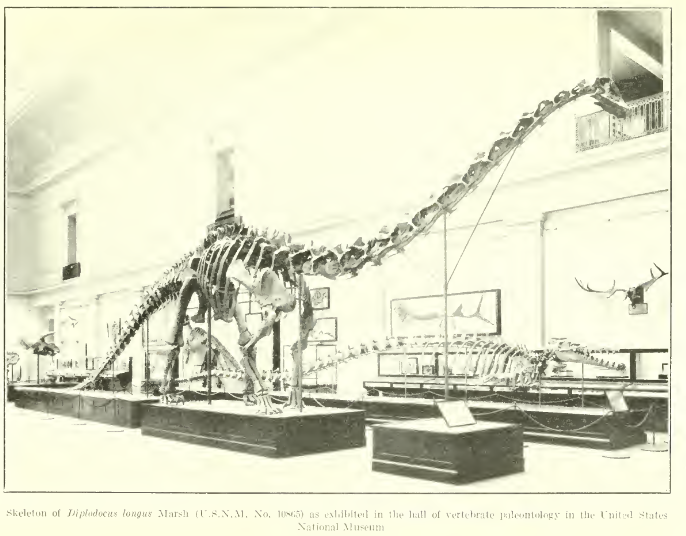
A funny thing is that his reconstruction of Diplodocus, with it rearing up onto its hindlegs and holding its spinal column in a straight line with the tail well above ground, looks almost modern if one just thinks away the water. And I believe there is a peculiar reason for that. Wilfarth notes the fused vertebral spines above the pelvis form a noticeable gap between those of the tail and back. He argues that this shows that the animal’s spine was generally not held in the convex posture, with the curved back and drooping tail you often see in old art, but that in life these gaps were closed, by the animal having its tail and back actually lifted up in a slight concave position (1949a, p. 47). Even if his misguided interpretation of this feature is that the sauropods regularly reared up in the water in order to breathe, the observation itself is remarkably prescient and actually predicts much later work. Vidal et al. 2020 used essentially the same observation in the sauropod Spinophorosaurus to argue that eusauropods have traditionally been reconstructed as too horizontal, with the pelvic vertebrae indicating that the front of the body was actually neutrally held up diagonally, as in giraffes, supporting the modern notion of these animals as high-browsers.
 |
| Fig. 5: Modern skeletal reconstruction of Spinophorosaurus, showing that, essentially, Wilfarth was right in thinking that the sauropod spine formed a light concave at the hip (Source: Vidal et al 2020). |
Wilfarth’s discussion of sauropod facial anatomy is also interesting in the modern day. Of course, the high nares on diplodocoids he interprets as a sort of whale-like blowhole, as was the style at the time. Ever since Witmer 2001 it has become unpopular to reconstruct the fleshy nostrils of these dinosaurs as sitting directly atop the nares, being instead shifted towards the snout-tip as in other reptiles and connected to the nares by a big, fleshy structure. I personally remain agnostic on this issue. There has been some pushback against an elaborate nose in recent years, mostly in online discourses by paleoartists, as there is no obvious sign on the snout of diplodocoids of any attachment sites for such an external flesh- or cartilage structure. As Hallett & Wedel (2016) and before them McLoughlin (1979) have argued, a blowhole might still make sense even in a terrestrial context, as it would have allowed the animal to more easily browse thorny trees or keep the nose dry when having to curve the neck and head down to drink. Where Wilfarth is again quite modern is in the discussion of macronarian noses. As he notes, their nares are so unusual and spacious that they simply must have housed big, elaborate soft-tissue structures (prefiguring Witmer 2001), that aided in breathing: “The nose of Brachiosaurus can be imagined balloon-like and extendable. Since the nasal bar is very narrow, one can conclude that the fleshy nose looked like a uniform structure. A well-functioning breathing-nose allowed the sauropod to exploit the wave-troughs and in turn significantly save on neck-length, since in the wave-trough the water surface is closer to the bottom.” (Wilfarth 1949a, p. 52, translated by me). Unfortunately for us he provides no illustrations of what he thinks that might have looked like.
Regarding sauropod dentition, Wilfarth argues that the teeth of animals like Diplodocus were spaced too far apart to have worked efficiently as rakes, therefore interpreting them not as herbivores but again as faunivorous “flesh-grazers” of the worm lawns, like the earlier plateosaurs (Wilfarth 1949a, p. 41 – 43). The conspicuous space between the teeth has interestingly been pointed out again in the modern day, though this time to support the idea that some sauropods may have had a supporting beak-like structure covering their teeth (Wiersma & Sander 2017).
 |
| Fig. 6: Wilfarth's thoughts on sauropods in water were oddly prescient. The ones about sauropods on land... not so much. Deja vu (Source: Wilfarth 1949a, p. 38). |
Where Wilfarth’s ideas (apart from the snorkel-neck) have aged the worst is in regards to sauropods on land. Here he argues that, because they did not have a well-developed femoral head, sauropods could not have walked on erect legs like other dinosaurs. Thus, he reconstructs the sauropod mother coming to land to lay her eggs as crawling on her belly. This of course recalls earlier reconstructions made by Hay, Tornier and Harder. Though Wilfarth (1938a, p. 270 – 271) notably criticizes Tornier for reconstructing Diplodocus with sprawled-out legs like a crocodile, because, like Holland before him, he accurately points out that this would have disarticulated the legs. So instead, he reconstructs the crawling legs as crouched and angled in line to the body. I guess this is marginally better than Tornier’s monstrosity, but would have made for an even more awkward gait.
Wilfarth distinguishes three major groups of sauropods, which lived at different water-levels. First there are the Schlickgrundbewohner (“Silt-bottom-dwellers”) which are roughly synonymous with the Diplodocoidea. These he imagines as inhabiting the deepest depths, during ebb even venturing out into the parts of the ocean that stayed permanently inundated. They spent their lives continually following the ebb and flow, up and down the tidal flats, systematically fauna-grazing on the way by digging up worms. They preferred grazing against the current, so that the silt-clouds their digging produced would not blind them. To breathe, they regularly reared up onto their hindlegs, using their whip-tails as an additional anchor in the silt like their saurischian ancestors did.
Next are the Sandgrundbewohner (“Sand-ground-dwellers”) in which Wilfarth includes smaller, more robust forms like Brontosaurus and Camarasaurus. These lived at shallower depths with stronger currents and mostly fed on above-ground critters like brachiopods and crinoids. They evolved more elaborate noses that allowed them to quickly breathe in and close their nostrils again during wave-throughs, so that they did not need to rear up to breathe like the diplodocoids.
Third are the Hocharmsaurier (“High-arm-saurians”) like Brachiosaurus (Wilfarth refers here mostly to Janensch’s Brachiosaurus brancai, which is today its own genus Giraffatitan). These Wilfarth regards as the only true quadrupeds among the sauropods, having completely given up the practice of rearing up to breathe and thereby also losing the whip-like anchoring tail. Instead, these saurians, in response to the lowering tidal range, came to solely rely on the length of their neck to breathe, hence why their fleshy nose became even more elaborate than in the sand-ground-dwellers.
“The Mudflatwalkers”
Die Wattenläufer (Struthiomimidae)
 |
| Fig. 7: A little coelurosaur running over a pavement of seashells after the tide has already retreated (indicated by the streamlines around the clams, as Wilfarth likes to point out). The dinosaur itself is directly based on a reconstruction of Compsognathus drawn by Gerhard Heilmann, though with the cute little detail that Wilfarth's version has a slight fin around the tail. (Source: Wilfarth 1949a, p. 16). |
Whereas the sauropods became more aquatic with the lowering tidal range of the Jurassic, the coelurosaurs that descended from the podokesaurids became more terrestrial. That these animals were mostly terrestrial runners Wilfarth (1949a, p. 18) cannot deny, due to their fused metatarsals, reduced toes and general similarity to birds. Though he argues that they still were not pure dry-land-animals. For one, the dry land during this time would still have been pretty poor in food sources compared to the tidal zone, for the other, he doubts that the long tails of these animals really were purely used for balance, because the very similar birds can walk bipedally without needing a long tail. Instead, the coelurosaur tails must have still served an additional swimming purpose, helping the animal traverse tidepools or escape from larger predators. He also has conflicting views on the hollow bones, noting, in comparison with the pneumatic bones of birds, that this is again another sign for a terrestrial lifestyle, though bizarrely he also speculates if the hollow cavities could have been filled with water during flow in order to make the animal heavier (Wilfarth 1949a, p. 15).
 |
| Fig. 8: Struthiomimus stealing eggs on the beach. Instead of a redraw, this is directly taken from one of Osborn's papers. Which is sad, because I would have liked seeing an ornithomimid with a swimming tail (Source: Wilfarth 1949a, p. 17). |
Wilfarth interprets the coelurosaurs of the later Mesozoic as beach-runners, always following the ebb and flow so that they could scavenge on the stranded animals left behind by the retreating waters or digging up small aestivating animals from their burrows. Additionally, he speculates that forms like Struthiomimus could have dug up and fed on the eggs of other dinosaurs or fished for small animals in tidepools. Being constantly on foot and also needing to run away from larger carnivores, he muses that they must have been quite fast Wilfarth 1949a, p. 17) and, similar to Heilmann, his illustrations indeed show the animals being active and dynamic, with the tail held well above the ground as in modern reconstructions. Compare this with other contemporary depictions like Disney’s Fantasia.
“The Big-Chunk-Predators”
Die Grossstückräuber (Megalosauridae)
 |
| Fig. 9: A Ceratosaurus feeding on a small ornithischian as the tide slowly approaches in the background. While Wilfarth says this is based on the Knight reconstruction, it reminds me more of a Heilmann piece (which also copied Knight), where the prey animal was Camptosaurus (Source: Wilfarth 1949a, p. 22). |
The big predatory theropods (what Von Huene and others would have called carnosaurs), Wilfarth imagines as evolving in the Late Triassic from small-fauna-pluckers similar to Plateosaurus, that, unlike the sauropods, responded to the lowering tidal range by becoming more terrestrial. These theropods first lived like larger versions of the beach-runners, following the tides to scavenge on stranded fish and reptiles, before Jurassic forms like Ceratosaurus and Allosaurus evolved short necks and huge jaws, becoming active hunters of other dinosaurs. While, as with the coelurosaurs, Wilfarth interprets these animals as mostly terrestrial animals, having obvious walking feet, he cannot wholly separate them from the sea. He argues again, using birds, that the long tails of these animals were simply too long to have served purely as counterbalance, and would have actually been a hindrance on land, as them being dragged around on the ground would have been an obvious risk for injuries. Nor could they have been a purely vestigial feature from an aquatic ancestor, as the tails seemingly became longer with time, with Tyrannosaurus of the low-tide Late Cretaceous having the most terrestrial feet yet also the longest tail, with its huge pubic foot, Wilfarth (1949a, p. 25 – 27) speculates, purely serving to keep the massive tail off the ground so it could not be injured. Ergo, the tail, despite its hindrance on land, must have kept a vital purpose, which Wilfarth claims was to be a propeller for swimming, allowing the big theropods to keep up their pursuit even if a hadrosaur or ostrich-dino fled into the water. This basically makes them big, mean, bipedal crocodiles.
 |
| Fig. 10: Tyrannosaurus rex standing in the surf zone of the retreating tide, perhaps pining for the fjords. Obviously based on the original reconstruction of the animal by Charles R. Knight (Source: Wilfarth 1949a, p. 27). |
The big flaw in Wilfarth’s argument is that he bases the supposed extraordinary tail-length of Tyrannosaurus solely off the famous (or rather infamous) AMNH 5027 skeletal mount, the original 1917 reconstruction of T. rex by Henry Fairfield Osborn. You may know it as the skeleton that served as the basis for the Jurassic Park logo. What Wilfarth does not seem to have known is that this mount was basically a Frankenstein’s monster, the museum having cobbled together parts of different specimens to fill out gaps in the incomplete skeleton, in the process adding way too many vertebrae to the tail than were present in the real animal (something funnily enough referenced in the original Jurassic Park novel). Wilfarth thus seems to have fallen victim to another person’s mistake, making it doubly ironic when he calls out paleoartists for not accurately portraying the tail-length of T. rex and accusing them of an actualistic bias (Wilfarth 1949a, p. 25 – 26).
 |
| Fig. 11: The famous T. rex mount AMNH 5027. The long, serpentine tail Wilfarth interprets as a feature used for swimming, not knowing that the tail-length in this mount was unknowingly exaggerated by the constructors (Source: Wilfarth 1949a, pl. 1). |
From a certain point of view Wilfarth still prefigures some thinkers of the Dinosaur Renaissance (apart from saying that tail-dragging theropods don’t make sense), like Gregory S. Paul (1988, p. 44 – 47), who debunked the old myth that hadrosaurs and sauropods could just flee into the water to escape their pursuers, because theropods could in any case easily swim as well if they had to.
Be sure to continue with part 3, where we look at how Wilfarth interpreted the ornithischian dinosaurs as aquatic and speculates on why the dinosaurs went extinct!
If you liked this and other articles, please consider supporting me on Patreon. I am thankful for any amount, even if it is just 1$, as it will help me at dedicating more time to this blog and related projects. Patrons also gain early access to the draft-versions of these posts and my art.
Related articles:
- Wilfarth's Great Tides and the Dinosaurs - Part 1
- Wilfarth's Great Tides and the Dinosaurs - Part 3
- The Alien Prehistoric World Trope - Part 2
- The weirdest things people have thought about pterosaurs
- The Ridoculus History of Sprawl-legged Diplodocus
- Diplodocus: A history of reconstructions - Part 1
- Diplodocus: A history of reconstructions - Part 2
- Why Brachiopods are actually pretty cool
- Paleopods: The myth of the predatory prosauropods that kinda turned out to be true
- "Hawkinspunk" Spinosaurus
Further Reading:
- Alien Planetology
- A Vast Quantity of Evidence Confirms that Non-Bird Dinosaurs were not Aquatic by Darren Naish
- Dinosaur Sex Lakes, Too Big to Walk and the Bizarre Theories of Brian Ford by C. M. Kosemen
References:
- Benton, Michael: Scientific Methodologies in Collision. The History of the Study of the Extinction of the Dinosaurs, in: Evolutionary Biology, 24, 1990, p. 371-400.
- Bertozzo, Filippo; Manucci, Fabio; Dempsey, Matthew; Tanke, Darren; Evans, David; Ruffell, Alastair; Murphy, Eileen: Description and etiology of paleopathological lesions in the type specimen of Parasaurolophus walkeri (Dinosauria: Hadrosauridae), with proposed reconstructions of the nuchal ligament, in: Journal of Anatomy, 238, 2020.
- Bonnan, Matthew & Senter, Phil: Were the basal sauropodomorph dinosaurs Plateosaurus and Massospondylus habitual quadrupeds?, in: Barrett, P.M.; Batten, D.J. (eds.): Evolution and Palaeobiology of Early Sauropodomorph Dinosaurs (Special Papers in Palaeontology 77), Oxford 2007, p. 139–155.
- Byrne, H. M.; Green, J.; Balbus, S.; Ahlberg, P: Tides. A key environmental driver of the osteichthyan evolution and the fish-tetrapod transition?, in: Proc. R. Soc. A, 476, 2020.
- Colbert, Edwin: Review. Die Lebensweise der Dinosaurier, in: Journal of Paleontology, 24, 1950, p. 116.
- Colbert, Edwin: Relationships of the Saurischian Dinosaurs, in: American Museum Novitates, 2181, 1964, p. 1 – 24.
- Cuvier, Georges: Discours sur les Révolutions de la Surface de la Globe, et sur les Changements qu’elles ont Produites dans la Regne Animal, Paris 1825.
- Desmond, Adrian: The Hot-Blooded Dinosaurs. A revolution in Paleontology, London 1975.
- De Winter, Niels; Goderis, Steven; Van Malderen, Stijn; Sinnesael, Matthias; Vansteenberge, Stef, Snoeck, Christophe; Belza, Joke; Vanhaecke, Frank; Claeys, Philippe: Subdaily-Scale Chemical variability in a Torreites Sanchezi Rudist Shell: Implications for Rudist Paleobiology and the Cretaceous Day-Night Cycle, in: Paleooceanography and Paleoclimatology, 35, 2020.
- Ekman, Martin: A Concise History of the Theories of the Tides, Precession-Nutation and Polar Motion (From Antiquity to 1950), in: National Land Survey. Division of Geodetic Research, S-801, 1993, p. 585 – 617.
- Fulda, Ernst: Die Entstehung der Zechsteinsalze nach der Grossflutenhypothese von Martin Wilfarth, in: Kali, 32, 1937a.
- --1937b: Die Grossflutenhypothese und ihre Anwendbarkeit auf die Entstehung der Salzlagerstätten, in: Forschung und Fortschritt, 14.
- --1938a: Steinsalze und Kalisalze, in: Beyschlag-Krusch-Vogt: Die Lagerstätten, 3, 2, Stuttgart.
- --1938b: Salze, in: Geologische Jahresberichte, 1.
- --1939: The Theory of the Great Tides and its Application to the Theory of the Formation of the Salt Deposits, in: Research and Progress, 5.
- Galton, Peter: Ornithischian Dinosaurs and the Origin of Birds, in: Evolution, 24, 1970, p. 448 – 462.
- Hallett, Mark & Wedel, Mathew: The Sauropod Dinosaurs. Life in the Age of Giants, Baltimore 2016.
- Heilmann, Gerhard: The Origin of Birds, London 1926.
- Holland, William Jacob: The Skull of Diplodocus, in: Mem. Carnegie Mus., 9, 1924, S. 379 - 404.
- Kermack, Kenneth: A note on the habits of the sauropods, in: Annual Magazine of Natural History, 12, 1951, S. 830 – 832.
- Knoll, Fabien; Galton, Peter; Lopez-Antonanzas, Raquel: Paleoneurological evidence against a proboscis in the sauropod dinosaur Diplodocus, in: Geobios, 39, 2006, p. 215 – 221.
- Loomis, Frederic Brewster: Momentum in variation, in: The American Naturalist, 39, 1905, p. 839 – 843.
- Matthew, William Diller: Dinosaurs, New York 1915. (Readable here)
- McLoughlin, John: Archosauria. A New Look at the Old Dinosaur, New York 1979.
- McLoughlin, John: Synapsida. A New Look into the Origin of Mammals, New York 1980.
- McLoughlin, John: The Tree of Animal Life. A Tale of Changing Forms and Fortunes, New York 1981.
- Naish, Darren: The response to and rejection of Brian Ford’s Too Big to Walk, a 21st century effort to reinstate the aquatic dinosaur hypothesis, in: Historical Biology, 2024.
- Nölke, Friedrich: Kann dem Monde ein Einfluss auf die geologische Entwicklung eingeräumt werden?, in: Bremer Beiträge zur Naturwissenschaft, 1935.
- Norman, David: The Illustrated Encyclopedia of Dinosaurs, London 1985.
- Paul, Gregory Scott: Predatory Dinosaurs of the World. A Complete Illustrated Guide, New York 1988.
- Romer, Alfred Sherwood: Osteology of the reptiles, Chicago 1956.
- Seeley, Harry Govier: On the Classification of Fossil Animals commonly named Dinosauria, in: Proceedings of the Royal Society, 43, 1887, p. 165–171.
- Sternberg, Charles Mortram: Were there Proboscis-bearing Dinosaurs? Discussion of Cranial Protuberances in the Hadrosauridae, in: Annals and Magazine of Natural History, 11, 1939, p. 556 – 560.
- Vidal, D.; Mocho, P.; Aberasturi, A.; Sanz, J. L.; Ortega, F.: High browsing skeletal adaptations in Spinophorosaurus reveal an evolutionary innovation in sauropod dinosaurs, in: Scientific Reports, 10, 2020.
- Wiersma, Kayleigh & Sander, Martin: The dentition of a well-preserved specimen of Camarasaurus sp.: implications for function, tooth replacement, soft part reconstruction, and food intake, in: Paläontologische Zeitschrift, 91, 2017, p. 145 – 161.
- Wilfarth, Martin: Sedimentationsprobleme in der Germanischen Senke zur Perm- und Triaszeit, in: Geologische Rundschau, 24, 1933, p. 349 – 377.
- --1934: Strömungserscheinungen im Wellenkalkmeer, in: Zeitrschrift der Deutschen Geologischen Gesellschaft, 86, p. 265 – 285.
- --1936: Die Gezeiten im Meere des Malm Zeta bei Solnhofen, in: Zeitschrift der Deutschen Geologischen Gesellschaft, 88, p. 57 – 61.
- --1938a: Die Sauropoden als Bewohner des Grossgezeitenraumes, in: Paläontologische Zeitschrift, 19.
- --1938b: Was hat die Grossgezeitenhypothese zum Problem der Erdölentstehung zu sagen?, in: Kali, 32, 1938b, H11.
- --1938c: Kalkfällung im Wellenkalkmeer, in: Beiträge des Geologischen Thüringischen Vereins, 5, p. 46 – 48.
- --1938d: Gab es rüsseltragende Dinosaurier?, in: Zeitschrift der Deutschen Geologischen Gesellschaft, 90, p. 88 – 100.
- --1939: Die Nasenbasis der Lambeosaurinae, in: Zentr. Bl. F. Min., 1, p. 24 – 39.
- --1940a: Der Atemrüssel der Hadrosauriden, Halle.
- --1940b: Die Umdrehung der Wirbeltierahnen, Halle.
- --1947: Rüsseltragende Dinosaurier, in: Orion, 2, 11/12, p. 525.
- --1948: Grossgezeiten in der Erdvergangenheit, in: Orion, 3, H 2/3, p. 79.
- --1949a: Die Lebensweise der Dinosaurier, Stuttgart.
- --1949b: Leben heute noch Saurier?, in: Prisma. Illustrierte Monatsschrift für Natur, Forschung und Technik, 4, 6.
- Wiman, C.: Über einige neue Lebendbilder von Dinosauriern, in: Paläontologische Zeitschrift 23, 1942, p. 237 – 249.
- Witmer, Lawrence: Nostril Position in Dinosaurs and Other Vertebrates and Its Significance for Nasal Function, in: Science, 293, 2001, 850 – 853.