
Welcome back to my
tour through the Swiss dinosaur museum of Aathal. Click here for Part 2. Let us just jump right in
with a few more exhibits I left out the last time.


We begin with the exhibit on Swiss dinosaurs (and other prehistoric reptiles). Tanystropheus from the Monte San Giorgio probably needs no introduction, being probably the most famous fossil organism originally found in Switzerland. Perhaps less well-known is Ticinosuchus from the same formation. It is a pseudosuchian archosaur known from three specimens, which probably lived along the Middle Triassic Swiss beaches before its carcass was swept out to sea to rest among the marine reptiles. It is notable for possibly being the animal responsible for leaving behind the various Chirotherium footprints across Central Europe. As is tradition with any animal associated with these prints, it is here shown producing them, though note that it is still controversial if Ticinosuchus really is the direct culprit or rather a closely related animal. Least well known, but all the more interesting is Sclerosaurus armatus, so far the oldest tetrapod found from Swiss strata, dating back to the Olenkian-Anisian of Basel-Stadt (if you are curious, the oldest vertebrate fossil in general from Switzerland is the fish Aeduella, accidentally found in Early Permian sediments during drilling tests in Weiach searching for potential radioactive waste storage sites. The oldest animal fossil in general is the Carboniferous cockroach Progonoblattina, which I always found to have a sort of symbolic irony, given how ridiculously prepared this country is for the case of a nuclear war). While at first glance it just looks like some random prehistoric lizard, it is actually a procolophonid, which were close relatives of the pareiasaurs and millerettids. In other words it is one of the few parareptiles (if you do not include turtles) that survived the Permian-Triassic mass extinction event. It is also the largest parareptile of the Triassic, to the point where it was once thought to be a late-surviving pareiasaur. The very lizard-like portrayal here betrays a bit of its unique anatomy, as judging by the skeleton, Sclerosaurus had a wider, more turtle-like ribcage and more dramatic horns projecting from the back of the head.


This exhibit was
made in 2006, when knowledge of dinosaurs in Switzerland was still a bit
rudimentary. As such, you here see Liliensternus prominently displayed, though
this animal is better known from South German skeletons and its existence in
Switzerland is mainly known from only teeth and a few bone scraps. In a modern
remake of this exhibit it would probably be replaced by Notatesseraeraptor,
a slightly smaller theropod described in 2019 (though discovered as far back as
2006), known from quite extensive remains and the first theropod native to this
country. It is interesting that this Liliensternus here is reconstructed
with a head very similar to Coelophysis. Most reconstructions depict it
with a pair of prominent headcrests, due to its possible close affinity with
famous Dilophosaurus. But alas, the complete skull of Liliensternus
is not actually known and its placement in the theropod family tree remains
controversial, so as far as I am aware, this is an equally valid
interpretation. It was by the way standing next to a life-sized model of a Plateosaurus
half-submerged in the mud-trap of the Tongrube Frick, but I already wrote
enough about that
animal and its locality.
Also showing its age, the exhibit labels the sauropod found it Moutier, here adorably
restored in life-size and with the classic nostril-placement, as Cetiosauriscus
greppini. The history of this specimen (or rather specimens, as the fossil
material might consist of at least four individuals) is rather interesting. After
being found in the 1860s, the remains were first thought to belong to a
theropod, due to being found alongside the tooth of a ceratosaur, and named Megalosaurus
greppini. After then being recognised as a sauropod it was classified under
Ornithopsis in 1922 and shortly after Cetiosauriscus. In 2020,
after nearly being forgotten, the remains of this animal were re-examined and
found to not actually be close to British Cetiosauriscus at all and
significantly distinct. Thus, it was renamed Amanzia, after geologist Amanz
Gressly, and is the first known sauropod genus native to Switzerland.


The majority of dinosaur material found in Switzerland are not body fossils, but footprints. Most prominent is a fossil trackway site from Courtedoux, which you see here restored as a miniature diorama, and other sites in Kanton Jura. Together, these preserve up to 14’000 individual footprints, 254 trackways of which could be attributed to sauropods, 411 to bipedal dinosaurs, making Jura possibly the most important site worldwide for Late Jurassic dinosaur ichnology (Meyer 2018). Unlike Germany at the time, which was mostly split up into small islands on which dwarf dinosaurs like Europasaurus lived, Northern Switzerland seems to have been a bridge between larger landmasses that was itself large enough to support an ecosystem comparable to what is found on the Iberian peninsula or the North American Morrison formation. We can find footprints here of Brachiosaurus-sized sauropods and a new ichnogenus, Megalosauripus transjuranicus, also indicates the presence of large theropods similar to Allosaurus in size. Of course, since these are all known only from footprints, this does not generate much wider interest in the public, since people think ichnofossils are more boring than skeletons, even though they can give us much deeper insight into dinosaur behaviour. Also displayed at the museum was a model of an Early Cretaceous trackway found in Kanton Nidwalden. As you can see here by the foot, it was produced by iguanodontids, probably about 6 meters in length. They were discovered in 2000 by pure coincidence by a geologist while he was swimming in Lake Lucerne.


After Swiss dinosaurs there was an exhibit dedicated to pterosaurs. There was not much to say about this one, as it was mainly some info-plaques and mounted skeletons and models. It has not changed much since its inception in 2003. The pterosaurs on the mural should however probably raise an eyebrow to anyone with good memory. It is a copy of Quetzalcoatlus as it was drawn by John Sibbick for Wellnhofer’s The Illustrated Encyclopedia of Pterosaurs from 1991. A neat inclusion in the exhibit was a little showcase about the early days of paleontology that tried to emulate what the desk of a Victorian era naturalist would be like.

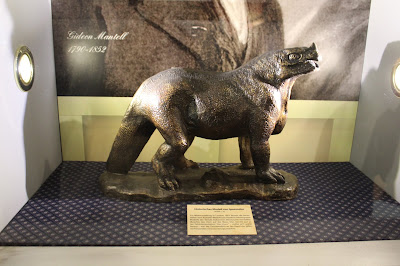
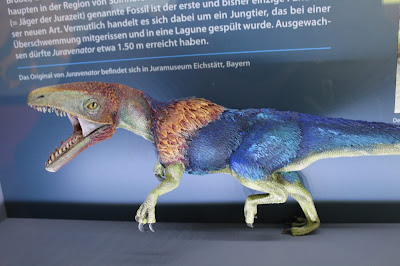
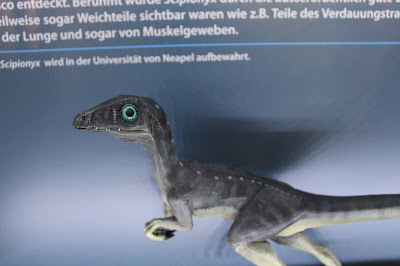
The exhibit on European dinosaurs was also neat, though mostly consisted of skeletal mounts, so there was not much paleoartistic stuff to talk about. Nonetheless nice were the miniatures of Hawkins’ Crystal Palace dinosaurs, as well as models of Juravenator and Scipionyx. The latter two have just become relevant again in paleo-media, as Andrea Cau has controversially argued that they and other compsognathids known from only juvenile remains do not actually form a natural group, but are really the chicks of various non-coelurosaurian theropods, with Scipionyx being a juvenile carcharodontosaurid and Juravenator and Sciurumimus being megalosauroids (which is actually not that new of a proposal). Since the latter two have direct evidence of proto-feathers, this has some significant implication for the distribution of integument-types in theropods. I am sensing another Spinosaurus revision /s.
One of the newest exhibits was one not directly about dinosaurs and new fossil finds, but instead about the impact dinosaurs have had on culture, especially merchandising. And my god, was it magnificent, a true collector’s dream. They literally had everything: Stamps, toys, pins, coins, books, movies, postcards, weird Japanese stuff, office utensils, movies, cookie cutters, mugs, holiday decorations, ornaments made from actual amber, alcoholic beverages and even sex toys! It is a true testament to how much impact these animals have had on us, despite having vanished long before we evolved. I really hope this one will stay permanently in the museum, because it is such a unique experience seeing all of this stuff at once that I do not think I have seen before in any other museum outside of maybe the gift shops.


That has been it for now, join me on the final part where we finally get to look at the actual main hall of the museum, marine reptiles and the outdoor area. Thank you for reading and see you until then!
If you liked this and other articles, please consider supporting me on Patreon. I am thankful for any amount, even if it is just 1$, as it will help me at dedicating more time to this blog and related projects. Patrons also gain early access to the draft-versions of these posts.
Related Posts:
- Visiting the Sauriermuseum Aathal - Part 1: The Howe Quarry Dinosaurs
- Visiting the Sauriermuseum Aathal - Part 2: Exhibits
- My Trip to the Dinosaur Museum of Frick
- Fossil Hunting in the Jura Mountains of Holderbank
- Gresslyosaurus: The Eldritch Dinosaur that turned its Discoverer insane?
Papers:

.png)

.png)


