

"Sauropods are basically alien animals . . . What can be said of the habits of an animal with the nose of a Macrauchenia, the neck of a giraffe, the limbs of an elephant, the feet of a chalicothere, the lungs of a bird, and the tail of a lizard?" is a rather well-known quote made by paleontologist Walter Coombs (1975) in a paper about sauropod life habits. Over the past 50 years our understanding of these giant dinosaurs has greatly improved, but Coombs’ initial assessment about these animals and their skeletons still holds at least some truth. Like Stegosaurus, there is simply nothing like these animals alive today and it should be no surprise that many paleontologists in the past had some considerable trouble imagining them as living beings. Today we will therefore go through the history of one of the most well-known sauropods: Diplodocus.
Earlier Sauropod Reconstructions
.jpg)
Fig. 1.
Diplodocus may be among the longest known, but certainly was not the first known sauropod. The first remains of such creatures, vertebrae and some limb bones, were uncovered in 1825 in Oxfordshire, England. When first sent to French vertebrate paleontologist George Cuvier, he simply identified them as belonging to a whale, despite coming from Mesozoic aged sediments. In 1841, a year before he would coin the name Dinosauria, Richard Owen examined the bones more closely and correctly identified them as belonging to a large reptile, not just because of the age, but also because the vertebrae were hollow (whale bones, like in most mammals, are solid). However, Owen would not go on to include the giant reptile in his definition of Dinosauria. Instead, he interpreted the animal as being a large relative of crocodilians, giving it the name Cetiosaurus, literally meaning “whale-lizard”. If ichthyosaurs and plesiosaurs were the Mesozoic equivalent to dolphins and pinnipeds, he believed Cetiosaurus was the reptilian version of an orca or sperm-whale, a giant marine crocodilian hunting the more diminutive sea-dwellers. Unfortunately for us, there exists no life reconstruction of Owen’s Cetiosaurus, at least not one made during the 19th century, though I imagine it looking similar in his mind to Jurassic World’s version of Mosasaurus. The above image you see is actually a mockery of the concept, drawn by John C. McLoughlin in 1979.
In 1850 Gideon Mantell re-examined additional material that was previously referred to Cetiosaurus and classified them as distinct enough to be their own genus, Pelorosaurus. He also correctly identified that Pelorosaurus was a large, land-living reptile and likely among the Dinosauria. The remains were still highly incomplete, so nothing was yet known of the characteristic long neck and tail of sauropods. As Mark Witton has already extensively written, life reconstructions from this period of sauropod research are pretty much non-existent until the 1880s.

Fig. 2
The first largely complete skeletons would instead come about during the Bone Wars between Marsh and Cope. The first hint towards the true shape of sauropods came in 1877 with Edward Cope’s description of Camarasaurus, with John A. Ryder reconstructing what was then known of the skeleton as best as he could.

Fig. 3.
The first life reconstruction of a sauropod, Atlantosaurus specifically (today a nomen dubium), appeared in 1886, being made by a certain J. Blanedet in a book called Le monde avant la création de l'homme (The World before the Creation of Man), by Nicolas Camille Flammarion. Given what was known at the time, it is actually surprisingly good, I would say, and takes many cues from modern monitor lizards, which is something actually seen again in many modern reconstructions, as the nasal cavities of monitors and sauropods do have some interesting similarities. Regarding the author of the book, Flammarion is actually more well-known for his writings on extraterrestrial life, helping perpetuate the belief of artificially made canals on Mars alongside Percival Lowell. Some connections you simply cannot escape.

Fig. 4.
The first truly classic sauropod skeletal came in 1896 with Marsh’s restoration of Brontosaurus. As is now famously known, Marsh did not know what the head of Brontosaurus actually looked like and when the skeleton was displayed in the Peabody Museum, it was reconstructed based off the heads of macronarian sauropods, such as Brachiosaurus

Fig. 5.
Cope briefly toyed with the idea that sauropods were giraffe-like high-browsers mainly living on land, but eventually he, Marsh and many other researchers at the time, fell back into the aquatic paradigm that Owen had laid out. Despite the strong, pillar-like legs, it was thought that sauropods must have lived most of their life in the water, in order to hold up all their weight, and used their long necks either as snorkels or to forage for aquatic plants. The latter was seemingly corroborated by the very small heads and strange teeth of sauropods, which at the time indicated that these animals could take in only little food and were bad at chewing, limiting their diet to soft aquatic plants and their metabolism to a low, reptilian level. Thus was born the classic image of the sluggish, cold-blooded, swamp-bound sauropod, which was possibly first illustrated in 1897 by Charles R. Knight in an article titled Strange Creatures from the Past for the Century Magazine (making it one of Knight’s oldest published pieces of paleoart). The genus depicted is Amphicoelias.

Fig. 6.
What is little known is that the drawing is based off an older sketch by Cope, seen above, which is actually rather mysterious, as its dating is unknown and Cope rather explicitly drew the animals as being bipedal, kind of like a giant version of a modern Plateosaurus. While the sketch is usually dated to around the same time as Knights’ drawing, Adrian Desmond (1975, p. 220) suspected that it could actually be significantly older, possibly from the 1870s, when it was still thought most or all dinosaurs were bipeds. If true, I propose that this image may attest to a very brief period in the timeline of sauropod research where these animals were imagined as giant bipeds.
From D. longus to D. carnegii

Fig. 7.
The genus Diplodocus was first described by O.C. Marsh in 1878 based off remains (YPM VP 1920) from the Garden Park quarry in Colorado, which were discovered by Benjamin Mudge and Samuel Williston. The specimen was very incomplete, consisting mostly of vertebrae, and yet it became the type specimen of Diplodocus longus. If described today, it would almost certainly be viewed as a dubious taxon, though an appeal to the ICZN in 2016 to make the later D. carnegii skeletons the new type for Diplodocus has failed. Until 1884, various new remains were uncovered and assigned to D. longus, among them USNM V 2672, a complete and articulated skull, which was also the first skull of a diplodocid known. Remember this specimen, we will come back to it in part 2.

Fig. 8.
Because of its fragmentary nature, no skeletal or life reconstruction exists of Diplodocus from the 19th century. However, as soon as the century turned, this changed. In 1899 and 1900 Jacob Wortman, John Bell Hatcher, William Jacob Holland and Charles Gilmore, with funding by Andrew Carnegie, uncovered two largely complete Diplodocus skeletons at Sheep Creek in Wyoming, CM 84 and CM 94. In 1901, Hatcher made CM 84 the holotype of a new species, Diplodocus carnegii, with the smaller CM 94 becoming the paratype. In his description Hatcher also provided the first full-body reconstruction of a Diplodocus skeleton. Apart from being quite low-slung, its tail is also notably shorter than we are used to nowadays, in many ways resembling Marsh’s earlier restorations of Brontosaurus.

Fig. 9.
This was quickly revised again in 1905 with Holland’s redescription for the museum mount, where Diplodocus finally got its characteristic long whiptail. Quickly, Diplodocus became not only an animal with a unique appearance, but also a record-breaker, as it was the longest dinosaur, let alone land animal, known up to that point.

Fig. 10
Holland’s paper was accompanied by this life reconstruction, possibly the first ever of Diplodocus, by Alice B. Woodward. It apparently had appeared earlier that same year in a May 13th issue of the Londoner magazine Weekly Graphic (Holland 1905). It likely also served as a base for a later image by Woodward appearing in Nebula to Man, by Henry Robert Knipe. It is an interesting reconstruction. While the animal is depicted as low-slung and probably rather sluggish, it is a lot leaner than many later depictions. The clawed, turtle-like feet are also closer to the real animal than in later reconstructions, which tended to give sauropods very simplified elephant-feet.

Fig. 11
Other life reconstructions where soon to follow, such as this famous painting by Charles R. Knight, made under the direction of Henry Fairfield Osborn for the American Museum of Natural History. It is notable that this reconstruction is somewhat at odds with Osborn’s own vision of sauropod lifestyles, as he was very much of the opinion that these animals were mostly water-dwellers, only venturing onto land on occasion (Desmond 1975, Hallet & Wedel 2016). The behaviour depicted here, standing on land proudly erected onto the hindlegs, is therefore more of a rare occurrence, meant to impress the museum-goers. The second individual on the right, doing its best Nessie-impression, seems deliberately tacked on to remind the viewer of how this animal is normally supposed to live. Ironically, the one on the left aged far better, as many researchers agree that diplodocids were capable of bipedal rearing, with some even arguing that this was how they most commonly browsed tree-tops (Hallett & Wedel 2016).
Dippy Drama

Fig.12.
Andrew Carnegie was ecstatic at the discovery of D. carnegii, obviously in part because the species was named after him. He was not satisfied with just displaying skeletals on paper, but instead wanted the whole skeleton to be mounted in his museum. Thus was born in 1907 Dippy, which was composed by Holland out of the holotype CM 84 and the smaller CM 94. However, even then the full skeleton could not be fully restored, which is why some minor parts were used from other sauropods. Most notably, the original skull of Dippy was a mold based off the specimen USNM 2673, which is today recognized as actually belonging to a wholly different species, Galeamopus pabsti (Tschopp et al. 2015). Despite this, Dippy was an impressive skeletal mount for the time and even gained international attention. Already in 1902, after having seen early sketches for the upcoming mount, King Edward VII. asked the Carnegie Museum if it is possible to procure another skeleton for the British Museum. The museum complied and sent out another expedition to Sheep Creek, but without luck, as no additional skeletons as good as the two CMs could be found. William Holland then had the brilliant idea of just copying the Dippy they already had by making plaster molds of every bone, which could then be shipped and reassembled overseas. And this is exactly what they did. The museum in fact made multiple copies of Dippy and shipped them not just to London, but also, in an act of philanthropy, to the natural history museums of Berlin, München, Paris, Wien, Bologna, St. Petersburg, La Plata, Madrid and Mexico City. Most of the shipments were accompanied by Holland himself, who supervised their assembly. The shipments became a Europe-wide media-sensation, Dippy quickly became the centrepiece of many museums and Diplodocus one of the household dinosaur names. According to some sources (Russell 1988), in French Diplodocus has become a generic term for sauropod, much like “brontosaur” in English. I have no way of confirming this, since I principally refuse to speak to French people.

Fig. 13.
Not
everyone was happy with Dippy’s world-tour. Already in 1905 during the unveiling
of London’s Dippy, a certain F. W. Frohawk asked the Carnegie workers if they
were certain about the pillar-erect limb position that they reconstructed the
dinosaur’s legs in. Possibly spurred by this, one of the paleontologists
working for the Carnegie Institute, Oliver Perry Hay, actually dissented with
the erect posture of the Dippy mounts. He argued that Hatcher and Holland had
gotten it wrong by assuming that a cold-blooded reptile of this size would walk
with upright elephantine legs like a mammal. Instead he thought that the
dinosaur would have walked with sprawled legs like a modern lizard or crocodile,
allowing it to rest most of its weight on the ground. Interestingly, in the same paper he also argued against sauropods being able to fully submerge themselves and using their necks as snorkels, with arguments that were rediscovered only decades later.
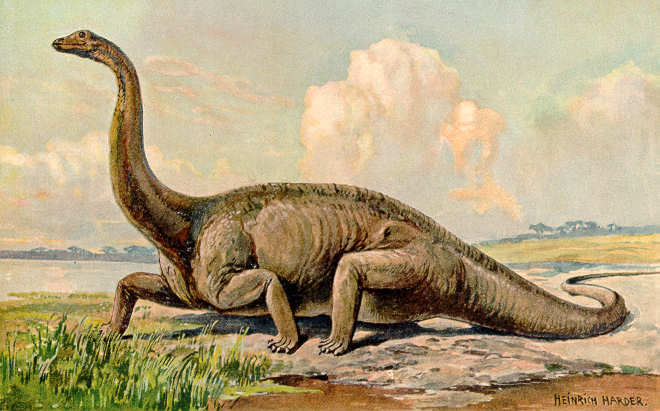
Fig. 14.
German paleontologist Gustav Tornier even drew a skeletal based off Hay’s proposal, which very likely served as the basis for the infamous life reconstruction by Heinrich Harder above. This whole idea did not survive the 1910s, for obvious reasons. Holland (1910) wrote a lengthy rebuttal to Hay’s and Tornier’s criticisms, finding a very critical flaw in them: Not only would all the limbs have been painfully disarticulated in such a position, the animal’s ribcage was deeper than the shoulders (something omitted in Tornier’s skeletal), meaning that if it had actually crawled with sprawled-out legs, the chest would have hung deeper into the ground than the feet, meaning it could have only been able to move forward if its belly was constantly hanging into a WW1-style trench.
This is just the beginning of the story. There is much, much more to write about the history of Diplodocus, which is why I decided to split this up into two parts. Next time we will look at the transformation of Diplodocus from a sluggish swamp monster into a “giraffosaur” and also look at some of the weird and controversial questions which have been asked about it. What did it eat? Did it have a trunk? Could it give live birth? How did it hold its neck? Do we actually know less about Diplodocus than previously assumed? Tune in next time to find out what people have thought in the past and present.
If you liked this and other articles, please consider supporting me on Patreon. I am thankful for any amount, even if it is just 1$, as it will help me at dedicating more time to this blog and related projects. Patrons also gain early access to the draft-versions of these posts.
Related Posts:
- The Alien Prehistoric World Trope: Part 2 - Dinosaurs become movie monsters
- The Ridoculus History of Sprawl-legged Diplodocus
- Visiting the Sauriermuseum Aathal - Part 1: The Howe Quarry Dinosaurs
Online Sources/Further Reading:
References:
- Augusta, Josef: Tiere der Urzeit, Prag 1956.
- Bakker, Robert Thomas: The Dinosaur Heresies. New Theories Unlocking The Mystery of the Dinosaurs and Their Extinction, New York 1986.
- Ballou, W. H.: Strange creatures of the past, in: The Century Illustrated Monthly Magazine, New York, 55, 1897, S. 15 -23.
- Colbert, Edwin: Men and Dinosaurs, London 1968.
- Coombs, Walter: Sauropod habits and habitats, in: Palaeogeography, Palaeoclimatology, Palaeoecology 17, 1975, p. 1-33.
- Desmond, Adrian: The Hot-Blooded Dinosaurs. A revolution in Paleontology, London 1975.
- Flammarion, Nicholas Camille: Le monde avant la création de l'homme: origines de la terre, origines de la vie, origines de l'humanité, Paris 1886.
- Gilmore, Charles Whitney: On a newly mounted skeleton of Diplodocus in the United States National Museum, in: Proceedings of the United States National Museum, 81, 1932, S. 1–21.
- Hallett, Mark/Wedel, Mathew: The Sauropod Dinosaurs. Life in the Age of Giants, Baltimore 2016.
- Hatcher, John Bell: Diplodocus Marsh, its osteology, taxonomy and probable habits, with a restoration of the skeleton, in: Mem. Carnegie Mus., 1, 1901, S. 1 – 63.
- Hay, O. P., 1908. On the habits and the pose of sauropodous dinosaurs, especially of Diplodocus, Am. Nat., 42, pp. 672-881.
- Holland, William Jacob: The osteology of Diplodocus Marsh with a special reference to the restoration of the skeleton of Diplodocus carnegiei Hatcher presented by Mr. Andrew Carnegie to the British Museum, in: Mem. Carnegie Mus., 2, 1905, S. 225 – 264.
- Holland, William Jacob: A review of some recent criticisms of the restoration of sauropod dinosaurs, with special reference to that of Diplodocus carnegiei in the Carnegie Museum, in: Am. Nat., 44, 1910, S. 259 – 283.
- Holland, William Jacob: The Skull of Diplodocus, in: Mem. Carnegie Mus., 9, 1924, S. 379 - 404.
- Marsh, Othniel Charles: The Dinosaurs of North America, in: Annual Report of the US Geological Survey, 16, 1896, S. 135 - 415.
- Martin et al.: Not cranes or masts, but beams: The biomechanics of sauropod necks, in: Oryctos, 1, 1998, S. 113 – 120.
- Matthew, William Diller: Dinosaurs. With special reference to the American Museum collections, New York 1915.
- Mcloughlin, John: Archosauria. A New Look at the Old Dinosaur, New York 1979.
- Osborn, H. F., and C. C. Mook. 1921. Camarasaurus, Amphicoelias and other sauropods of Cope. Memoirs of the American Museum of Natural History, n.s. 3:247-387 and plates LX-LXXXV.
- Osborn, Henry Fairfield: Cope. Master Naturalist, Princeton 1931.
- Popular Science Monthly, Vol. 72, 1908, S. 440.
- Probst, Ernst: Tiere der Urwelt. Leben und Werk des Berliner Malers Heinrich Harder, Norderstedt 2014.
- Russell, Dale: An Odyssey in Time. The Dinosaurs of North America, Minocqua 1988.
- Taylor et al.: The long necks of sauropods did not evolve primarily through sexual selection, in: Journal of Zoology, 824, 2011, S. 1 – 12.
- Tschopp, Emanuel/Mateus, Octavio/Benson, Roger: A specimen-level phylogenetic analysis and taxonomic revision of Diplodocidae (Dinosauria, Sauropoda), in: PeerJ, 3, 2015.
- Wells, Herbert George: A Short History of the World, London 1922.
- Witmer, Lawrence: Nostril Position in Dinosaurs and Other Vertebrates and Its Significance for Nasal Function, in: Science, 293, 2001, 850 – 853.
Image Sources:
- Fig. 1: McLoughlin 1979.
- Fig. 2: Osborn & Mook 1921.
- Fig. 3: Flammarion 1886.
- Fig. 4: Marsh 1896.
- Fig. 5: Ballou 1897.
- Fig. 6: Wikimedia
- Fig. 7: Marsh 1896.
- Fig. 8: Hatcher 1901.
- Fig. 9: Holland 1905.
- Fig. 10: Holland 1905.
- Fig. 11: Wikimedia
- Fig. 12: Popular Science Monthly, Vol. 72, 1908, S. 440.
- Fig. 13: Hay 1908.
- Fig. 14: Probst 2014.


