Thursday, 1 February 2024

Skull drawing of Kaatedocus siberi

Just a random drawing I did of the Kaatedocus siberi HQ2, a diplodocid discovered by the Swiss Siber-team at the Howe Quarry of Wyoming. This is just something I did because I was bored and is not at all accurate to the real thing (as I am still inexperienced at drawing things from life), so it should not be used as a reference.

Tuesday, 2 January 2024

Gorgoraptor

Click to enlarge

While Ryl Madol teems with creatures that are extinct anywhere else in the world, dinosaurs (and really anything else past the Palaeozoic) are sadly absent. In their stead have evolved other, stranger creatures. Among them are the lycaenoraptors, of which Gorgoraptor is a member. Though bipedal and digitgrade like theropods, the saberteeth and faint hairs along the back show that these are in fact some kind of therapsid, descending from the likes of gorgonopsians, therocephalians or perhaps even cynodonts. 

Using their great sense of smell and decent eyesight, these small-to-medium-sized predators opportunistically stalk the forest undergrowth in search for prey. While its smaller relatives live in packs, Gorgoraptor often hunts alone. When it captures prey like lodosaurs, it pins them down with its powerful legs and arms and deals the killing blow by severing their windpipe with its characteristic saberteeth. It itself can fall prey to the much larger Carptophoneus, the anteosaurid(?) "tiger" of the island, and of course the titanic Decarnodon, an anamniote reptiliomorph that could give even large theropods like T. rex a run for their money.

As, unlike true mammals, these synapsids still have full colour-vision like other amniotes, they can often be found with striking patterns and colour schemes. Apart from charismatic stripes, the mane along the neck and back can also shine in bright colours. Perhaps, long ago in the distant past, this is how hair first got its start, not as a means of insulation but as a display feature.

Related Posts:

Monday, 1 January 2024

Diogenesaurus

Click to enlarge

In the tropical jungle of Ryl Madol, perhaps the same home as that of Eurhinocaulus, a strange fellow can be encountered. A biped, both feather- and furless. But, contra Plato, it is not man, nor even really mammal.

Although now heavily altered and resembling more a dryosaur-type dinosaur than anything else, the two small tusks growing behind the beak still give away the true ancestry of this Paleozoic survivor. It is a dicynodont therapsid which has learned to walk on two almost humanoid legs. With these, as well as its horizontal pupils, it is well-equipped to evade the predators which may lurk among the giant horsetails and zosterophyl-flora. Yet, these little herbivores still tend to fall prey to the likes of lycaenoraptors and aistoboids. 

But those are a story for another time.

If you liked this and other articles, please consider supporting me on Patreon. I am thankful for any amount, even if it is just 1$, as it will help me at dedicating more time to this blog and related projects. Patrons also gain early access to the draft-versions of these posts.

Related Posts:

Saturday, 30 December 2023

Eurhinocaulus: The Sawfish Lepospondyl

Click to enlarge

Another round of speculative fun with prehistoric animals. What you see here is not a reconstruction of a real fossil, but a purely hypothetical relative or descendant of the famous lepospondyl Diplocaulus, an "amphibian" from the Permian ("amphibian" is in quotation marks since Lepospondyli, even if they did have similar physiology and lifestyles, are generally considered to have been members of Reptiliomorpha, therefore more closely related to us than to the actual modern (liss)amphibians). 

The lifestyle of this creature can be imagined quite straight-forwardly: It lies in wait on or inside the riverbed and when suitable prey is located, it lifts its head, its "skullwings" acting as hydrofoils to quickly dart the predator up (as they are theorized to have done in the real Diplocaulus). Once in reach, the toothed sword-nose is used to strike at the prey and incapacitate it, much as in sawfish.

This is simply a one-off creature without any wider context... for now. Who knows, perhaps it could become part of a future project.

Edit: Well, it happened!

If you liked this and other articles, please consider supporting me on Patreon. I am thankful for any amount, even if it is just 1$, as it will help me at dedicating more time to this blog and related projects. Patrons also gain early access to the draft-versions of these posts.

Related Posts:

Friday, 8 December 2023

My First Book: The Saurus Family and the Little Trilobite

Well, as you have probably noticed, I have not made as many blogposts this year as in the previous ones. This was due to a lot of reasons, like work, study, new hobbies and some personal struggles. But one of the more pleasant reasons was that I have in fact been working on a book! Now what could this book be? A compilation of Manospondylus posts? A history of paleontology? A spec-evo book? A science fiction novel? An encyclopedia of Swiss fossils? NOPE, none of the above. It is a children’s book about cartoony prehistoric animals! Illustrated all by myself.

CHECK IT OUT HERE

NOW ALSO AVAILABLE IN GERMAN 

The Saurus Family and the Little Trilobite follows an odd week in the life of Mr. and Mrs. Saurus, a married couple consisting of an Ichthyosaurus and a Plesiosaurus living on the coast of Vindelicia. One fateful day they find a trilobite in their underwater garden, which they soon realize is an animal which should not exist anymore in their time. The news of their major discovery spreads and various parties become interested in the little arthropod, but not for any good reasons. What will Mr. and Mrs. Saurus do now faced with this situation? Keep the critter as a pet? Sell it? Eat it? Well, that is for you to find out.


Now, of course, this is a silly story with a lot of factual errors (dinosaurs did not use forks to eat, for example). So, in addition, the book has a second half, which offers information on the real-life background behind all the animals that appear in the story, including more naturalistic illustrations. While this book is aimed at younger audiences, I hope some of the information will also be new for some of the more mature audience. Have you for example ever wondered what the longest fossil invertebrate was? Or how thalattosuchians moved on land? In addition, expect a lot of paleo-insider gags sprinkled throughout the whole book.


The book measures 21 x 21 cm and is 84 pages long. It is currently priced at 15.99 €‎ or 16.99 $. I published it through Amazon’s self-publishing service and it should be available on all storefronts. There are some coloured images in it, which (for reasons unclear to me) the Australian and Japanese storefronts will unfortunately not be able to print in full colour. My location in Switzerland has also made it difficult to send myself test-versions, so if there are any unforeseen printing errors because of that I apologize in advance and promise to fix those as soon as possible. A German version is now also available.

This is the first ever book I have published, so I hope you all like it. I am looking forward to your thoughts, opinions and constructive criticism.

Related Posts:

Thursday, 30 November 2023

Sauriermuseum Aathal - 2023 Update

It has been a while, hasn’t it? Not just on this blog (I have been quite busy, both with work and art), but also at the beloved Sauriermuseum Aathal, where a lot of things have been updated. If you have missed it, I have made four posts talking about the museum as of 2021. Now a lot of things have already changed again, in part because of the great migration of some of the original Howe Quarry fossils to the Zoological Museum of Zürich where I work at.

One big change is already visible at the entrance. The old Stegosaurus model that used to stand here has now been graced with a brand new Spinosaurus! What a magnificently made, short-legged croco-duck. Let us see how long it will take for it to become outdated.


In the Howe Quarry Hall not much has seemingly changed, but that is deceiving. The three skeletons of Big Al II, Barbara (Nanosaurus) and H.Q. 1 (Diplodocus) have been replaced with replicas, because this year they went on tour in Hong Kong and next year in March they will stand in the museum in Zürich.


A new exhibit (replacing the old one about dinosaur footprints) is dedicated towards fossil fish from around the world. This one was pretty great, not just because the specimens were all quite fantastic, but because it also went into the evolution of fish and the origin of tetrapods. All-around great stuff.


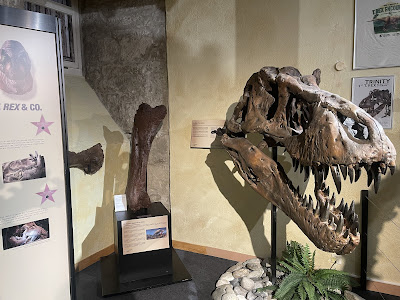
Now, the real reason why I returned was the new exhibit all about everyone’s favourite dinosaur, Allos… I mean, Tyrannosaurus rex. This was originally only supposed to last until the end of August, but was thankfully extended to the end of 2023, which allowed me to still see it in time. Originally, this exhibit coincided with the presentation of the skeleton Trinity at Zürich’s auction house in March. If you have been following this blog since then, you will know that said skeleton has since been sold to the Phouebus Foundation, which plans to place it in a museum in Antwerpen. But said museum is still being built, so where will Trinity stay until then? I have actually been informed by direct sources, but I am not allowed to tell (yet).
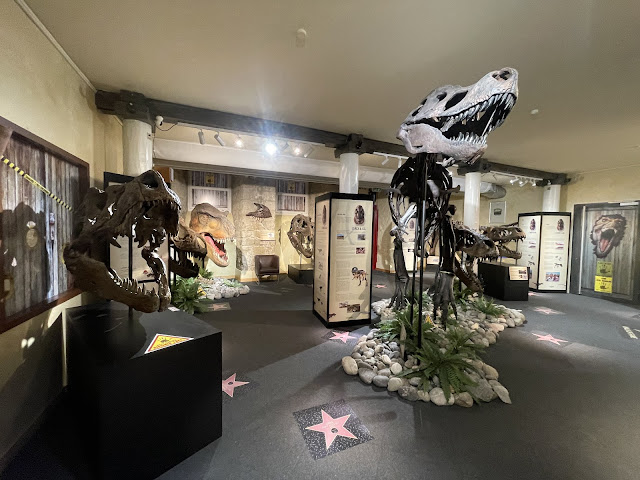


This year’s T. rex exhibit was actually too large for the museum, so it had to be built in a room in the neighbouring restaurant, which of course profited from the endeavour by renaming itself “Dino Beizli” (Beiz being Swiss-German for a bar or saloon). The centrepiece of the exhibit was the skeleton of “Rocky”, a teenage T. rex first discovered in 1998 in South Dakota. He was surrounded by skulls of others tyrannosaurs (replicas). Among them were Scotty, AMNH 5027 (aka, the one used in the Jurassic Park logo), Stan and Sue.


In addition to the skeleton of an Alioramus, there were also skulls of other tyrannosauroids, like Tarbosaurus and Albertosaurus. What will probably ruffle some feathers is that the skull of Jane (BMRP 2002.4.1) was labelled (probably correctly) as a juvenile T. rex while CMNH 7541 was presented as Nanotyrannus, without much comment as far as I can remember. Feel free to spam the comment section about this. 

Also in the room was a couch in front of a projector which played some low-budget CGI documentary about the tyrant lizard. The narrator, I was pleasantly surprised, was Otto Clemens, who some readers may also know as the narrator of the German dub of Walking with Dinosaurs and its spin-off shows. To any Anglo-Saxon readers unfamiliar with him, seriously listen to this version, Kenneth Branagh is milquetoast compared to his voice. As a little kid I always had the impression he was God himself talking about his own creations.


And with these images of T. rex paraphernalia I leave behind Novemeber. Stay tuned for another post soon, since I have some big news from my side to announce!

If you liked this and other articles, please consider supporting me on Patreon. I am thankful for any amount, even if it is just 1$, as it will help me at dedicating more time to this blog and related projects. Patrons also gain early access to the draft-versions of these posts.

Related Posts: