A likely reason for
what makes dinosaurs so appealing to us today is that they combine the familiar
with the unfamiliar. We can see attributes of giraffes, rhinos, turtles or
birds in sauropods, ceratopsians, ankylosaurs and theropods, recombined in ways
that feel both alien yet still understandable. However, there is at least one
group of dinosaurs that one can describe as truly alien with no modern
analogues and those are the stegosaurs. A bird-like tiny head sits on a long
neck attached to a massive body, with almost comically disproportionate limbs
and a tail that looks more like a medieval weapon than a biological structure.
And then there is of course the famous, strangely arrayed backplates and
spikes, the likes of which, to paraphrase John Foster, can arguably only be
found elsewhere in the lobopods of the Cambrian. The true strangeness of Stegosaurus
and its close relatives is something that can be underappreciated at times and
nowhere else is this as apparent as when looking back at the history of people
trying to piece this animal back together. In many ways, the history of reconstruction
of this genus might be a good test case for what might happen one day should
mankind ever try to reconstruct multicellular fossils on another planet like
Mars.
The earliest years with Stegosaurus armatus
The first known
remains of a Stegosaurus (YPM 1850) were described by Othniel Charles
Marsh in 1877, during the midst of the infamous Bone Wars. The material,
uncovered by Arthur Lakes north of the town of Morrison in Colorado, was highly
incomplete, mostly consisting of a few vertebrae, other postcranial bones and a
single of the famous dorsal plates. There were also teeth and limb bones
assigned to the specimen, but these later turned out to have actually belonged
to a Diplodocus and an Allosaurus respectively (Carpenter &
Galton 2001). Despite the incompleteness, YPM 1850 was still assigned to be the
holotype of a new dinosaur species, Stegosaurus armatus, because Marsh
was Marsh and the Bone Wars were the Bone Wars. The genus name Stegosaurus means
“roofed lizard” and derives from Marsh’s initial interpretation of the animal.
He believed that the backplates of the animal were similar to those of the
Cretaceous stem-turtle Atlantochelys and thus interpreted them as lying
flat on the back like roof-tiles to form a carapace (Marsh 1877). What later
turned out to be tail-spikes were also initially interpreted as part of the
dorsal armor, perhaps sticking out between the plates. Marsh’s initial vision
of the animal was a sort of turtle-like dinosaur that lived mostly in water,
but when coming out on land would walk bipedally. The latter idea derives in
part from the disproportionate length of the limbs (though mind you some of
these came from an Allosaurus, as mentioned), but also because it was
commonly thought between the 1860s and the 1870s that all dinosaurs were
bipeds, as the most complete dinosaur skeletons up to that point were those of Hadrosaurus
and Dryptosaurus (Laelaps). Only in the same year as Marsh’s
description was it made apparent that some dinosaurs were indeed quadrupeds,
when Edward Drinker Cope sketched the first skeletal for Camarasaurus.

Fig. 1
Marsh provided no
restoration for YPM 1850. The first known artistic depiction of Stegosaurus
instead appeared in the 51st issue of the Scientific American, on the
29th November of 1884. The illustration was made by a certain A. Tobin, whose
full name and further information I have unfortunately never been able to
uncover. The article the above illustration appeared in was not about Stegosaurus
specifically, but about dinosaurs in general and advances in paleontology, as
such there is not much information behind the reconstruction and the purpose of
the image was simply to show readers of the time what dinosaurs were like in
the flesh. Tobin seems to have based it roughly on Marsh’s initial description,
though still has taken some liberties. The dinosaur is presented less
turtle-like and instead fairly lean, with an outline and posture more typical
of other dinosaur depictions at the time. This is very apparent thanks to the
other dinosaur standing behind it (which the description in the article
identifies as Compsognathus, which is very strange, as not only were the
two genera geographically separated from each other, but Compsognathus was only
about the size of a chicken). What is notable and perhaps prescient about
Tobin’s depiction is that it shows at least some of the plates sticking out of
the skin instead of lying flat on top. Though this may also be coincidental to
create a tail similar to that of a crocodilian.
Edit from 2023: As kindly pointed out by fan of the blog Zain Ahmed, after I had written this post a new paper has been published by Eric Buffetaut in the journal Historia Natural, which sheds some light on the many oddities about "Tobin's" Stegosaurus. It did in fact not first appear in the Scientific American and the artist's name was not even Tobin! The above image first appeared in a paper written by French paleontologist Henri Emil Sauvage (interesting nominative determinism there) which was published on October 11th 1884 in a short-lived popular science magazine named Science et Nature. As it turns out, the full name of the illustrator was Auguste Michel Jobin, a scientific illustrator who has made more paleoart that has sadly been forgotten about (though Buffetaut announced in his paper that he will examine it in a future publication). Furthermore, the dinosaur identified in the SA article as Compsognathus was actually labelled as "compsonote" in Sauvage's paper, which is most likely a misspelling of Comptonotus, an old name for Camptosaurus, an iguanodontian that indeed lived together with Stegosaurus in the Morrison. It seems a lot of things have been confused or lost in translation when the image was re-used by Scientific American.
Of Ungulatus, Stenops and the first
skeletal
Even before Jobin,
Marsh got busy with his stegosaurs. In 1879 already, Lakes found for him
several more stegosaur fossils in the famous Como Bluff. Among them was YPM
1853, which was the holotype for the new species Stegosaurus ungulatus.
It was a lot more complete than the previous specimen, preserving parts of the
skull, many of the vertebrae, limb bones, backplates and tail spikes. In the
following years Marsh went on to describe two further species, S. affinis
and S. duplex, but these were based off specimens that were either too
simple to deserve distinction or are lost today. A breakthrough was made in
1885, when Marshall P. Felch uncovered USNM 4934 at the Garden Park quarry in
Colorado. The stegosaur was not only very complete, but fully articulated. This
made it the best glimpse into the true anatomy of Stegosaurus up to that
point. Based off it, Marsh described it as the new species Stegosaurus stenops
in 1877. On a side note, another species was named by him the same year with Stegosaurus
sulcatus, based off USNM V 4937. S. sulcatus is rarely talked
about but still notable, as it is probably still valid and possibly the only Stegosaurus
species that possessed shoulder-spikes similar to other stegosaurs like Kentrosaurus
(Galton 2010).

Fig. 2.
Based on all this
new information, Marsh published the very first full skeletal of a Stegosaurus
in 1891, which you can see above. This is likely also the most well-known
illustration of the animal, as it has been reproduced in art and books too many
times to count. Despite its prominence, there are many particularities about it
that often go uncommented. Firstly, instead of basing it off the skeleton of
the largely complete S. stenops, Marsh tried to depict
the more incomplete S. ungulatus with this skeletal, filling in blank
areas with data from S. stenops and other Stegosaurus. Therefore, this skeletal is a composite of many specimens, which as we
will see, would have some grave consequences down the line. Secondly, there is
the arrangement of the famous backplates. Marsh had by now realized that they
did not lie flat, but instead grew erect out of the skin, as the attachment sites for the skin and flesh were only at one end of the plate instead of one whole surface. However, the way he
imagined them to be patterned differed strongly from our modern vision. Marsh
interpreted the plates to all grow behind each other in a single line along the
spine. Possibly, this is what forced the dinosaur into such a dramatically arched
position, as otherwise Marsh could not have fit on all the plates on the back. There is a chance some
of you might still be familiar with this arrangement, as Stephen Czerkas
briefly tried to revive this idea in 1987, using the arrangement of spikes on
modern lizards like iguanas as an argument. While in scientific circles this
never went anywhere, Czerkas’ single-plate-line model was still popular enough
to become the basis for the Stegosaurus toy in the very first Kenner toyline
for 1993’s Jurassic Park (when the dinosaur finally appeared in the
movie’s sequel, it thankfully sported the more conventional plate arrangement,
but still came with many other problems, including being twice as large as the
real animal). Lastly, there is
the number of spikes on the tail, which is eight instead of the conventional
four. Marsh curiously knew that S. stenops only had four spikes, but
thought S. ungulatus had more, as he found up to nine of them with the S.
ungulatus holotype. Because the skeleton was mixed together with multiple
individuals, Marsh did consider that the spikes were from two or more different
tails, but concluded that eight came from a single individual, because his
analysis did not consider them to be duplicates (Carpenter & Galton 2001).

Fig. 3.
While quite
strange from a modern perspective, Marsh’s first skeletal reconstruction would
have a wide-reaching effect. One of them was that it would form the basis for
the actual mount of S. ungulatus at the Yale Peabody Museum, which was
likewise constructed of multiple individuals. While Richard Swann Lull modified
the mount in 1924 to make the plates paired, it did bear eight tail spikes for
the majority of its history. The popularity of this skeleton is therefore
likely one of the largest reasons why the idea persisted for so long that S.
ungulatus can be distinguished from S. stenops by having eight
instead of four tail spikes. Today it is thought that Marsh made a mistake in
his assumptions and that S. ungulatus really did only have four spikes like
its relative (Carpenter & Galton 2001). It is still neat to know this bit
of history, as it means that any time you see a Stegosaurus with eight
spikes in old paleoart, it is most likely meant to depict S. ungulatus.
Another long-lived legacy of Marsh’s comes from his 1896 monograph The
Dinosaurs of North America, in which he emphasizes the nervous system (or
rather lack thereof) in Stegosaurus. While Marsh never actually did
claim that the hollow cavity in the hip vertebrae was the resting place of a
second brain, he suggestively talks about it in strong relation to the small
size of the skull’s brain cavity. It was therefore very easy to simplify
Marsh’s writing as claiming that Stegosaurus had such a small brain in
its skull that it needed multiple nerve centers to operate different parts of
the body. Thus was born the unfortunate myth of the butt-brained dinosaur. Today
it is thought that the hip-cavity instead housed a glycogen reserve, as it very
much still does in some modern birds.

Fig. 4.
Marsh’s work was
shortly thereafter followed by the first life reconstruction of the “new” Stegosaurus
with a single plate-line and eight tail-spikes, appearing in the popular book Extinct
Monsters from 1893, by H.N. Hutchinson, illustrated by Dutch zoology illustrator Joseph Smit.
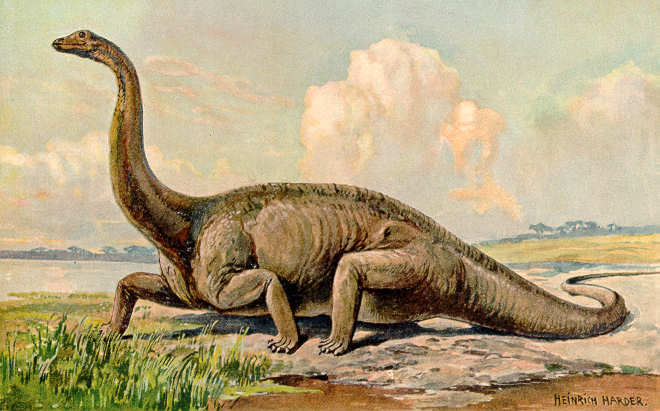
Differing from Marsh’s skeletal, which had more elephantine limbs, the animal is presented here crawling almost
like a lizard or a crocodile and indeed many reconstructions from the late 19th
century, such as those of Heinrich Harder, would emphasize the reptilian nature
of the animal with such postures. In part, this may have been due to the growing
dogma at the time about dinosaurs as a whole being just overgrown lizards,
though one can also imagine that this was done in part to also make this almost
alien creature seem more familiar.
Fig. 5
A strange
intermezzo from the general trend appeared in 1899, with this illustration by
Frank Bond under the guidance of a certain W.C. Knight from the University of
Wyoming (Gilmore 1914). While the general outline of the body seems to have
taken notice of Marsh’s skeletal, the arrangement of the armour is a genuine
throwback to his original idea from 1877 of a “turtlesaur”, making this
illustration pretty anachronistic. Ironically, it also shows the animal to be
more flexible and dynamic than usual at the time and it would take over half a
century before someone would consider again the possibility of Stegosaurus
being able to rear up on its hindlegs.
Fig. 6
1901 saw perhaps
the most classic of the old depictions of the animal, drawn by none other than
Charles R. Knight, though under the guidance of Frederic Lucas, at the time a
curator for the Smithsonian Institution (Gilmore 1914). Lucas commissioned the
painting to portray his new idea that the plates of Stegosaurus were not
all aligned in a single line, but instead grew in pairs. Unlike modern
depictions, he and Knight thought them to have been arranged in bilateral
symmetry, meaning the plates mirrored each other. To give credit where credit
is due, most people would probably agree that this was the more intuitive
interpretation than what we ended up with today. Long into the early 20th
century, Richard Swann Lull would still defend the paired-plate model and, as
mentioned, would have the Yale mount display it. A few other notable things
about Knight’s first reconstruction are how dark and menacing he drew the
animal and how he gave it a hooked beak, something not apparent in the real
animal’s skull (which, I personally think, when viewed up close, has actually more of a
resemblance to early ornithopod skulls, like Camptosaurus). Despite
this, portraying Stegosaurus with an almost eagle-like head would become
a minor paleoart trope, appearing most prominently in the first illustrated
version of Arthur Conan Doyle’s The Lost World.

Fig. 7.
Less than a year
after Knight’s painting, Lucas already revised his model and instead concluded
that the plates of Stegosaurus were arranged in an
alternating/glide-symmetric pattern (Gilmore 1914), meaning they did not mirror each other but instead formed a
distinct left and right side. The main reason for this is that the plates are
actually arranged this way in the type specimen of Stegosaurus stenops
(which is why the dinosaur here only has four tail spikes). This is also the
reason for why this reconstruction remains the dominant one today. While it has
been argued that the alternating pattern could be an artefact of taphonomy, the
completeness and articulation of the skeleton argues against this and other
specimens also show signs of such chirality (Cameron et al. 2016). In the same
year of 1901, Lucas commissioned a drawing of this new hypothesis from a
certain G.E. Roberts, which is most likely the very first depiction of Stegosaurus
in art with an alternating plate-arrangement (Gilmore 1914). Unfortunately, the
drawing here is not very good, especially anatomy-wise, and was not widely
publicized at the time, only appearing years later, in 1910, in an article for
the magazine Outdoor Life (Gilmore 1914).


Fig. 8 & 9.
Thankfully, Lucas
commissioned Knight again in 1903 to recreate Roberts’ version, but with a more
robust anatomy (Gilmore 1919). This time it was in the form of a miniature wax
model. Knight would use this as a basis for a gigantic life-sized model of S.
stenops, which was originally produced for and exhibited in the World’s
Fair of St. Louis of 1904 (Gilmore 1919). Its exhibition at said World’s Fair
is possibly one of the reasons why the alternating plate-model was also the one
that became more prominent with the wider public than any other interpretation.
After the fair, the model would go to the United States National Museum, where
it would accompany the S. stenops skeleton USNM 6531. As I have never
been to that museum, I do not know what happened to this model. If you know
more about its whereabouts, please tell.
Edit: As a friendly commenter has informed me, "Steggy the Stegosaurus" has thankfully survived to modern day, but has been transferred from the Smithsonian to the Museum of the Earth, in Ithaca, New York State. Thank you Abel Alfonso for this info!
Fig. 10.
In 1915, Charles
Whitney Gilmore, who has been a great resource on the early history of Stegosaurus,
would create his own little life model of the critter. It is similar to Knight’s, albeit more
gracile and compact.
Fig. 11.
Unfortunately for
Gilmore, the only time his model would be referenced was in a newspaper article
of the Ogden Standard-Examiner from the 15th of August 1920 (which is NOT April
Fools day). Written by a man named W.H. Ballou, who had previously worked as
an illustrator for Edward Drinker Cope, the article titled “The Aeroplane
Dinosaur of a Million Years ago” seriously proposes that Stegosaurus was
capable of not only flexing its backplates, but also using them to glide through
the air! How Ballou came to such a conclusion is hard to discern, though the
notion that birds descended from dinosaurs was still en vogue at this time and
Ballou emphasizes the fact that Stegosaurus was part of the
Ornithischia, the bird-hipped dinosaurs. While we today know that birds
actually descend from the Saurischia, Ballou obviously did think that there is
a close connection (as did others before him) and could therefore have very well concluded that
some members of the group could have also experimented with other forms of
flight. While obviously ridiculous, the idea did curiously reappear again in
1930 in the novel Tarzan at the Earth’s Core by Edgar Rice Burroughs. Yes,
THE Tarzan gets attacked by such “aeroplane dinosaurs” in this story. As far as
I know, it is not known if Burroughs actually did read this fairly obscure newspaper
article or separately came up with the concept by himself.
The classic years
Fig. 12.
Stegosaurus appeared again in spectacular fashion (and thankfully
on the ground) in 1933’s classic King Kong, brought to life by Willis
O’Brien in glorious stop-motion. The dinosaur is the first prehistoric animal
that the protagonists meet on the island and not only is it presented as larger
than life, but also requires a multitude of rifle shots to be brought down. It
is notably the last prominent depiction to show the plates being arranged in
pairs and likely was based off Knight’s first reconstruction. Instead of
a beak it also seems to sport scaly lips. People forgetting that Stegosaurus had
a beak of some kind is strangely prevalent in some pop-culture-depictions, with
even the Jurassic World movies making this error (made doubly strange
with the older The Lost World: Jurassic Park actually getting this
detail right). One could speculate that this is intentionally done to make the
animal more reptilian (and therefore probably monstrous), as beaks are
something associated more with birds, but then again, turtles have beaks too. A
genuine lack of even the most basic research might therefore be the more likely
reason.

Fig. 13.
1940 saw the next
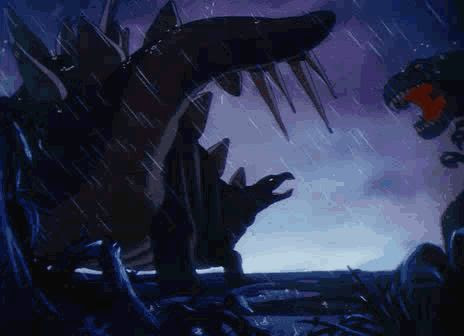
prominent appearance of Stegosaurus in film with Walt Disney’s Fantasia,
which I have already written about. As is typical, the animal is presented as downright
lardy and ponderous when in a peaceful mood. Notably though, when locked in a
fight against a T. rex (which yes, is very anachronistic), the dinosaur
is shown being mobile and prominently uses its tail as a defensive weapon. As
far as I am aware, this scene is indeed the first time that Stegosaurus
is shown using its weapon in this fashion in any sort of media. This was in
fact the reason why Stegosaurus was used in this scene over Triceratops
(who was originally planned for it) because the animators were very excited at
the opportunity of finally showing this dinosaur using its natural weapons in
the way scientists thought it did at the time (Culhane 1983). One has to keep
in mind that the Rite of Spring segment of Fantasia was also
meant to be partially educational, at a time long before actual dinosaur
documentaries as we know them existed.

Fig. 14.
Excluding such
highlights, the general view of Stegosaurus from the 30s until
the early 70s was as the quintessential embodiment of everything “wrong” with
dinosaurs, as we can see here on the famous Zallinger mural from 1947: a large
mass of fat, muscle and armour, with barely a brain to control this bulk. Due
to the disproportion of the dinosaur’s limbs, it was usually interpreted as a
very awkward walker, with erect hindlegs and sprawled forelimbs, which made the
whole front-portion of the dinosaur low-slung. Together with the bizarre armour
and notions of phylogeronty (the idea that groups of animals could age like an
individual person and, when too long-lived, degenerate), Stegosaurus was
interpreted as a misshapen creature whose evolution had clearly invested in the
wrong traits and was then left directionless, destined for extinction.
Fig. 15.
A related view can be seen in the 50s with Czech paleontologist Josef Augusta’s
writings, wherein stegosaurs are described “like living, impassable fortresses,
like armored battle vehicles of primevally wonderful construction […]” (Augusta
1957). Living in the Cold War environment behind the Iron Curtain, Augusta
seems to have been interested in the combative nature of the dinosaur. That this
militaristic description is immediately followed by Augusta perpetuating the
myth of Stegosaurus being so stupid that it needed two brains, paints this
interest, however, in a less glorifying light and might instead be viewed as
social commentary on the political environment at the time. This view of Stegosaurus,
a beast that invests too much in weaponry and is too stupid to even consider
other options (and is thus destined to fail), could easily be interpreted as a
caricature of the Soviet Union, the United States or even both at the time. The
images accompanying Augusta’s descriptions, made by none other than Zdeněk
Burian of course, are largely typical of the time. Unlike most artists before
him, though, Burian did pay a lot of attention to the fossil skull, even if,
like with Knight, the reconstruction ended up a bit too birdlike. As Zoe Lescaze
(2017) notes, depicting the dinosaur from behind was also a bold and unusual decision
at the time that showcases how confident Burian felt in his skills.
Growing appreciation and some experimentation
Fig. 16.
With the beginning
of the 70s also began what we all know as the Dinosaur Renaissance. Renewed
fascination and appreciation for the terrible lizards made many researchers
reconsider their preconceived notions and this not only led to dinosaurs being
seen more as successful, metabolically active creatures, but also gave rise to
many quite unorthodox hypotheses about dinosaur anatomy, behaviour and
lifestyles. While Stegosaurus continued to be depicted as a rather
ponderous animal even during the early years of the Renaissance, its weird
features were already subject to new interpretations. The obvious point of
contention were again the backplates and the question if and how they could
have been used as defence. One of the first of such reinterpretations came in
1975 from a popular book by Beverly Halstead, illustrated by Giovanni Caselli.
Halstead not only reverts the arrangement of the plates back to a bilateral
one, but also opines that they stuck out to the sides like wings, as he thought
that in this position they would act a lot better to deter predators. This idea never
caught on, as in this position, there would likely not have been enough muscle-
and ligament-support to hold the plates in such a fashion and any theropod
smart and agile enough would have probably been able to simply bite the animal’s
flanks underneath the armor. To give credit where credit is due, Halstead was
also of the opinion that the front legs of Stegosaurus would have been
held erect like pillars, instead of bent like in earlier reconstructions, as
this makes the most structural sense for such a heavy animal. This idea would
go on to become consensus.

Fig. 17.
A year later,
Ronald Raul Ratkevich and his illustrator, the
one and only John C. McLoughlin, presented an interesting behavioural hypothesis.
While keeping the erect and chiral arrangement of the plates, they thought that
Stegosaurus defended itself by rolling up into a defensive wheel, the
plated back thus forming a spiked wall. This has also never caught on, as
theropods would have probably been smart enough to approach the stegowheel from
a convenient angle and bite right in the unprotected center. An interesting
detail regarding this reconstruction is that, as far as I am aware, it is the
only one that also shows the spikes on the tail as being arranged with
glide-symmetry. While an interesting thought, this does not seem to have been
the case in reality. Another interesting detail is that this is possibly the
first reconstruction since Frank Bond’s from 1899 that depicts Stegosaurus
as being capable of rearing up bipedally.
Fig. 18.
It would be a
disservice to not mention an unusual, though rather influential event in
stegosaur research, which is Gary Larson publishing this little comic in 1982.
Although merely a silly joke, ever since Kenneth Carpenter used it in a 1993
lecture, the term “thagomizer” has actually become a regular name used by many paleontologists
for the tail weapons of stegosaurs and even some other dinosaurs. The bones
they work with may be dry, but their humour certainly is not.
Fig. 19.
Not everyone was
on board with the Dinosaur Renaissance and especially in popular books older
ideas and traditions of illustrations persisted, as showcased by this spread
from 1985’s The Illustrated Encyclopedia of Dinosaurs by David Norman.
As is pretty obvious, Norman’s skeletal here is basically the same as the one
Marsh drew in 1891, just with the plates updated. Despite its often
anachronistic nature, the “Normanpedia” would nevertheless go on to be quite
popular and influential among younger readers, thanks to John Sibbick’s
colorful life reconstructions. Thus the vision of ponderous Stegosaurus still lived on in the popular mind.
Fig. 20.
The next year saw
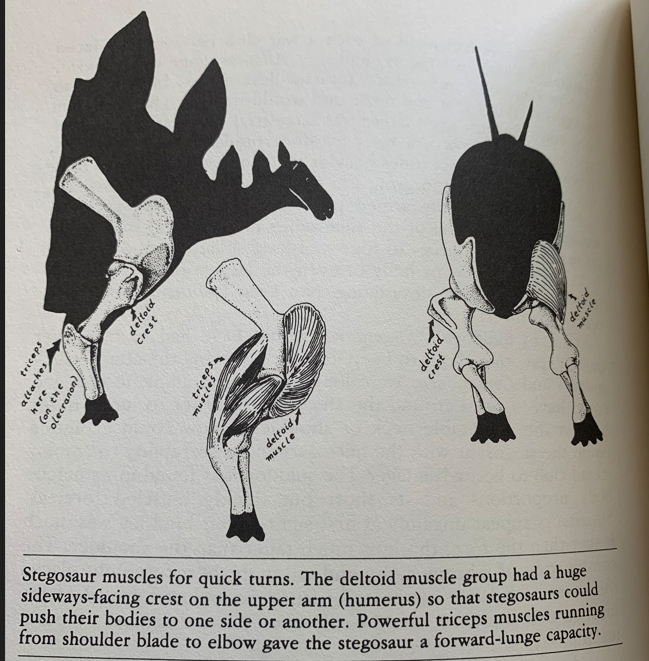
the landmark release of Robert Bakker’s The Dinosaur Heresies, where
Bakker gave the animal the full Renaissance treatment. Bakker insisted, like
Halstead, that Stegosaurus walked with erect front legs, but also that
the animal’s shoulder bones could move independently from the ribcage, as in
mammals, giving it more flexibility and making it a more efficient quadruped. Bakker
furthermore reinforced the idea that Stegosaurus actively used its tail
as a weapon, as the tail, unlike in other ornithischians, lacked ossified
tendons, giving it far greater flexibility. The mismatch in length between the
hind and front limbs also gave the animal a great ability to quickly circle
its behind in the direction of an attacker. These are all ideas still very much
supported today (in part because we have actually found thagomizer-spikes
deeply imbedded in the bones of allosaurs). However, Bakker also had some ideas
that still seem unorthodox today. I already wrote about his hypothesis that stegosaurs
regularly reared up on two legs to browse on tall plants. Stegosaurs being
facultative bipeds is actually supported today by trace fossils called Garbina
from Early Cretaceous Australia (Salisbury et al. 2016). Another interesting
idea of Bakker’s, unintentionally echoing Ballou, was that the dinosaur could
independently move its plates into a defensive position when threatened thanks
to muscles attached at the bases. Although
once prominently featured in a popular 90s documentary, this has also never
caught on, likely because there is not much evidence for such muscle attachments.

Fig. 21.
The end-point of
the Renaissance-era developments could perhaps be represented by this skeletal
from 2010 by Gregory S. Paul. While the weirder ideas from the 70s and 80s have
not persisted, the dinosaur has still undergone many updates compared to older
reconstructions. The tail and head are now held clearly above the ground and
the dinosaur strides on erect legs. Paul also bothered to include the fact that
Stegosaurus actually had throat armour made of smaller ossicles,
something actually known since the discovery of the S. stenops type
specimen. Paul has also covered the plates in keratin sheaths, something which
was confirmed by skin impressions from close relative Hesperosaurus
(Christiansen & Tschopp). In general, it was however still a bizarrely
proportioned animal, which was soon about to change.
New girl, new times
Fig. 22.
Since Marsh’s first
description of the order Stegosauria, many new species related to Stegosaurus
had been found all around the world, such as Kentrosaurus, Dacentrurus,
Huayangosaurus, Miragaia, Hesperosaurus and the deceptively
named Gigantspinosaurus. These revealed a rather surprising thing, which
was that the genus Stegosaurus, despite giving the whole group its name,
was actually a quite unusual stegosaur. Most other stegosaurs did not have a such dramatic limb proportions, had dorsal spikes in addition to plates, prominent
shoulder-spikes, long necks and in general long-stretched bodies. One thing
that someone had to consider, however, was that up until the 2010s nearly all skeletals
of Stegosaurus, including the one by Paul from before, were composites
of multiple individuals, as most specimens were either not completely preserved
or were hard to access for such skeletal reconstructions. The last complete
description of the genus was also all the way back in 1914 by Charles Gilmore. This
all changed in 2015 with the description of “Sophie” (SMA RCR0603/ NHMUK PV R36730), a specimen of Stegosaurus stenops.
Sophie was originally discovered in 2003 in the Red Canyon Quarry and excavated
by the team from the
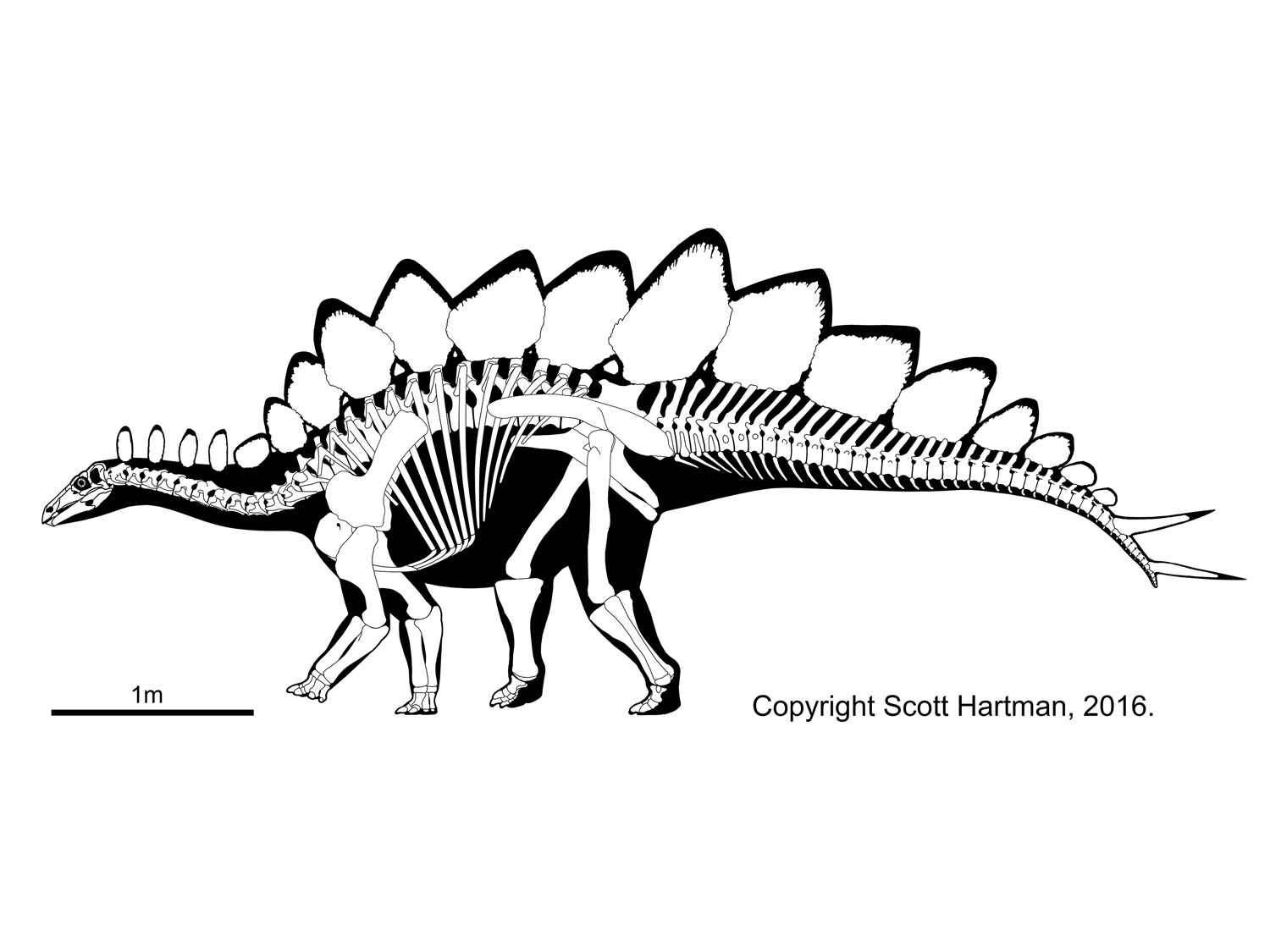
Swiss Sauriermuseum. Sophie is the most complete Stegosaurus skeleton
known to date and has given many new insights into the actual anatomy of the
genus. Most importantly, the skeleton shows that Stegosaurus was not actually
all that different from other stegosaurs, as we can see here in Scott Hartman’s
skeletal from 2016, based on Sophie. The difference in length between the limbs
is not as pronounced as was once assumed, the spine is more evenly horizontal,
the chest is shallower and the neck is longer. Though more similar now to its brethren,
Stegosaurus still has some unique traits, such as the lack of shoulder
spikes (except for S. sulcatus) and the plates running all the way from
the head to the tail tip. It also remains the largest member of the
Stegosauria.
This is highly
unlikely to have been the last chapter of Stegosaurus’ history. The only
constant, not just in nature but also science, is change, and there still remain
many questions regarding this peculiar creature from so long ago, more removed
in time from Tyrannosaurus rex than is humanity. Were the plates just
there for display or were they really used in defence? Did Stegosaurus
eat from tall plants or was it a low browser? Did it have a low bite force and
only ate the softest plant parts or had it a tougher diet? Is the gradual
extinction of stegosaurs linked to sinking cycad-populations? Did some
stegosaurs survive in India until the End Cretaceous? What were its facial
tissues like? Did the beak extend all around the rims of the jaw or did it have
lips and cheeks? What colours did it have? Did it care for its young or live in
herds? How did it interact with other herbivorous dinosaurs? Is the small size
of the brain really indicative of exceptionally low intelligence? How many Stegosaurus
species are there really? These are all questions that
remain open or are at the very least highly debated. Some may be answered in
the future, some may be not. What is sure is that Stegosaurus is and
will remain an icon of fascination, even in the (highly improbable but not impossible) case that Hartman's reconstruction will one day be as ridiculed as Jobin's is today.
If you liked
this and other articles, please consider supporting me on Patreon. I am
thankful for any amount, even if it is just 1$, as it will help me at dedicating
more time to this blog and related projects. Patrons also gain early access to
the draft-versions of these posts.
Related Posts:
References:
- Augusta, Josef: Tiere der Urzeit, Prag 1956.
- Augusta, Josef: Verwehtes Leben, Prag 1957 (Deutsche
Übersetzung von Max Schönwälder).
- Bakker, Robert
Thomas: The Dinosaur Heresies. New Theories Unlocking The Mystery of the
Dinosaurs and Their Extinction, New York 1986.
- Ballou, W. H.:
Strange creatures of the past, in: The Century Illustrated Monthly Magazine,
New York, 55, 1897, S. 15 -23.
- Ballou, W.H.: The
Aeroplane Dinosaur of a Million Years ago, in: The Ogden Standard-Examiner, 15.
August 1920, S. 8.
- Buffetaut, Eric: The first life reconstructions of dinosaurs Stegosaurus and Camptosaurus, in: Historia Natural, 13, 2023, p. 121 - 133.
- Cameron, R. P; Cameron,
J. A; Barnett, S. M.: Stegosaurus chirality, 2016.
- Carpenter, Kenneth
& Galton, Peter: Othniel Charles Marsh and the Myth of the Eight-Spiked
Stegosaurus, in: Carpenter, Kenneth (Hg.): The Armored Dinosaurs. Bloomington
2001, S. 76–102
- Christiansen,
Nicolai/Tschopp, Emanuel: Exceptional stegosaur integument impressions from
theUpper Jurassic Morrison Formation of Wyoming, in: Swiss Journal of
Geosciences, 103, 2010, p. 163- 171.
- Culhane, John:
Walt Disney's Fantasia, New York 1983.
- Czerkas, Stephen:
A Reevaluation of the Plate Arrangement on Stegosaurus stenops, in: In
Czerkas/Olson (Eds.): Dinosaurs Past & Present, 2, 1987, Seattle. p. 82–99
- Galton, Peter:
Species of plated dinosaur Stegosaurus (Morrison Formation, Late Jurassic of
western USA: New type species designation needed, in: Swiss Journal of Geosciences,
103, 2010, p. 187 – 198.
- Gilmore, Charles
Whitney: Osteology of the armored Dinosauria in the United States National
Museum, with special reference to the genus Stegosaurus, in: Smithsonian
Institution United Stated National Museum Bulletin, 89, 1914.
- Gilmore, Charles
Whitney: A newly mounted skeleton of the armored dinosaur Stegosaurus stenops
in the United States National Museum, in: Proceedings U. S. National Museum,
54, 1919.
- Halstead, Beverly:
The Evolution and Ecology of the Dinosaurs, Somerset 1975.
- Lescaze, Zoe:
Paleoart. Visions of the Prehistoric Past, Köln 2017.
- Maidment, Susannah
Catherine Rose; Brassey, Charlotte; Barrett, Paul Michael: The Postcranial
Skeleton of an Exceptionally Complete Individual of the Plated Dinosaur
Stegosaurus stenops (Dinosauria: Thyreophora) from the Upper Jurassic Morrison
Formation of Wyoming, U.S.A., in: PLoS One. 2015.
- Marsh, Othniel Charles: A new order of extinct Reptilia (Stegosauria)
from the Jurassic of the Rocky Mountains, in: American Journal of Science, 3,
1877, p. 513 – 514.
- Marsh, Othniel
Charles: Restoration of Stegosaurus, in: American Journal of Science, 3, 1891,
S. 179–81.
- Marsh, Othniel
Charles: The Dinosaurs of North America, in: Annual Report of the US Geological
Survey, 16, 1896, S. 135 - 415.
- Paul, Gregory
Scott: The Princeton Field Guide to Dinosaurs, Princeton 2010 (2. Edition
2016).
- Ratkevich, Ronald
Raul: Dinosaurs of the Southwest, Albuquerque 1976, S. 56.
- Revan, Ariel:
Reconstructing an Icon. Historical Significance of the Peabody’s Mounted
Skeleton of Stegosaurus and the Changes Necessary to Make It Correct
Anatomically. (Bachelorarbeit Yale University, 2011).
- Salisbury, Steven;
Romilio, Anthony; Herne, Matthew; Tucker, Ryan; Nair, Jay: The Dinosaurian
Ichnofauna of the Lower Cretaceous (Valangian-Barremian) Broome Sandstone of
the Walmadany Area (James Price Point), Dampier Peninsula, Western Australia,
in: Journal of Vertebrate Paleontology, 36, 2016, p. 1 – 152.
- Volpe, Rosemary:
The Age of Reptiles. The Art and Science of Rudolph Zallinger’s Great Dinosaur
Mural at Yale, New Haven 2007.
Online
Sources/Further Reading:
Image
sources:
- Fig. 1: Dinosaurs,
in: Scientific American, 51, 29. November 1884.
- Fig. 2: Marsh
1891.
- Fig. 3: Revan
2011.
- Fig. 4 – 7:
Gilmore 1914.
- Fig. 8 – 10:
Gilmore 1919.
- Fig. 11: Ballou 1920.
- Fig. 12: King Kong,
copyright by RKO Pictures.
- Fig. 13: Fantasia,
copyright by Walt Disney Pictures.
- Fig. 14: Volpe
2007, foldout.
- Fig. 15: Augusta
1956.
- Fig. 16: Halstead
1975, p. 63.
- Fig. 17: Ratkevich
1976, p. 56.
- Fig. 18: Wikimedia
- Fig. 19: Norman
1985, p. 154.
- Fig. 20: Bakker 1986.
- Fig. 21: Paul 2010
(2016), p. 249.
- Fig. 22: Scott
Hartman's website


.jpg)